
Few sci-fi franchises have stood the test of time like the Planet of the Apes series. What started as a weird, philosophical 1968 film based on a French novel blossomed into a decade-spanning epic full of time travel, nuclear wars, talking chimps, and groundbreaking CGI. But with ten movies spread across multiple timelines, reboots, and alternate realities, sitting down for a marathon can feel incredibly confusing.
If you want to dive into this post-apocalyptic universe without losing your mind, you need a clear roadmap. Luckily, there are a few distinct ways to tackle this cinematic puzzle. This comprehensive guide breaks down exactly how to watch the Planet of the Apes movies in order, ensuring you catch every twist, narrative arc, and historic cinematic moment without missing a beat.
Why This Topic Matters
The Planet of the Apes franchise is unique because it handles time loops and massive historical leaps differently than almost any other Hollywood series. It is not just about hyper-intelligent chimps taking over the world; it is a deep mirror held up to human nature, war, and class struggles.
Understanding how to watch the Planet of the Apes movies in order changes how you view the stories. If you watch by release date, you experience the evolution of Hollywood special effects from simple prosthetics to breathtaking motion-capture technology. If you watch chronologically, you witness a tragic loop where the future always seems destined to repeat itself. Knowing the paths helps you choose the perfect viewing experience for your taste.
Overview Table: The Complete Planet of the Apes Universe
Before diving into the detailed summaries, here is a snapshot of all ten movies in the franchise, including their release years and where they sit across the different timelines.
| Movie Title | Release Year | Timeline Group | IMDb Rating (Approx.) |
| Planet of the Apes | 1968 | Original Saga | 8.0/10 |
| Beneath the Planet of the Apes | 1970 | Original Saga | 6.0/10 |
| Escape from the Planet of the Apes | 1971 | Original Saga | 6.3/10 |
| Conquest of the Planet of the Apes | 1972 | Original Saga | 6.1/10 |
| Battle for the Planet of the Apes | 1973 | Original Saga | 5.4/10 |
| Planet of the Apes | 2001 | Standalone Remake | 5.7/10 |
| Rise of the Planet of the Apes | 2011 | Caesar Reboot Trilogy / Modern Saga | 7.6/10 |
| Dawn of the Planet of the Apes | 2014 | Caesar Reboot Trilogy / Modern Saga | 7.6/10 |
| War for the Planet of the Apes | 2017 | Caesar Reboot Trilogy / Modern Saga | 7.4/10 |
| Kingdom of the Planet of the Apes | 2024 | Modern Saga | 7.0/10 |
Chronological Order: The Ultimate Storyline Timeline
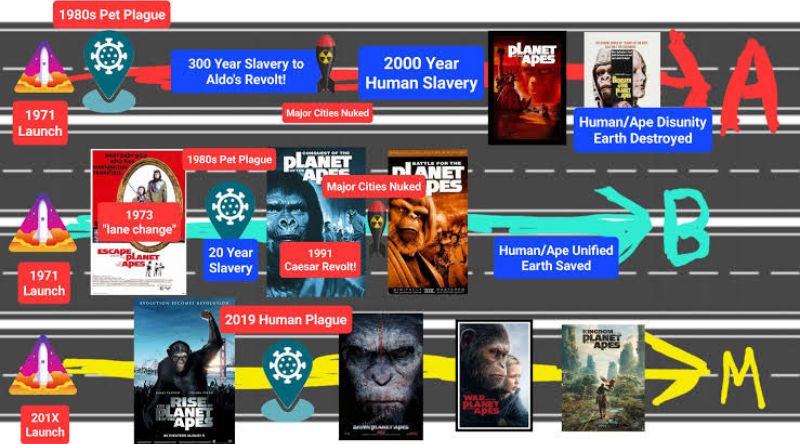
If you want to watch the events unfold exactly as they happen within the universe’s fictional history, this is the list for you. Keep in mind that the original 1970s films eventually circle back on themselves due to time travel, creating a loop.
Here is the exact layout of the main films when organized chronologically by the story’s in-universe calendar.
The Complex Timelines of the Apes Universe. Source: Reddit
Item #1: Rise of the Planet of the Apes (2011)
This film serves as the definitive starting point for the modern continuity, introducing us to a brilliant chimp named Caesar who develops human-like intelligence.
Rise of the Planet of the Apes (2011). Source: IMP Awards
Set in modern-day San Francisco, the movie follows a scientist trying to cure Alzheimer’s disease using an experimental viral drug. Instead, he accidentally creates a super-virus that kills off most of humanity while giving apes advanced cognitive abilities. Caesar leads an ape uprising, escaping into the redwood forests and setting the stage for a new global order.
| Key Metric | Details |
| In-Universe Year | Approx. 2011–2016 |
| Main Protagonist | Caesar (Andy Serkis) |
| Core Theme | The dangers of scientific hubris and the spark of revolution |
| Major Event | The outbreak of the Simian Flu |
Item #2: Dawn of the Planet of the Apes (2014)
Taking place a decade after the first film, this installment showcases a fragile world where humans struggle to survive while apes thrive in a growing society.
The story follows Caesar as he tries to maintain peace between his growing community of intelligent apes and a desperate enclave of human survivors in San Francisco. Trust completely fractures when radical factions on both sides push for all-out war. It is widely considered one of the emotionally strongest films in the entire franchise due to its incredible motion-capture acting.
| Key Metric | Details |
| In-Universe Year | Approx. 2026 |
| Main Protagonist | Caesar vs. Koba |
| Core Theme | Trust, leadership, and the inevitability of conflict |
| Major Event | The outbreak of the Ape-Human War |
Item #3: War for the Planet of the Apes (2017)
This dark, intense chapter serves as the conclusion to Caesar’s personal trilogy, framing his story like a biblical epic.
Caesar and his followers are forced into a deadly conflict with a rogue military faction led by a ruthless Colonel. As the Simian Flu mutates, causing remaining humans to lose their speech and primitive cognitive functions, Caesar struggles with his own dark impulses for vengeance. The movie ends with a massive exodus that cements the apes’ status as the new dominant species on Earth.
| Key Metric | Details |
| In-Universe Year | Approx. 2028 |
| Main Protagonist | Caesar |
| Core Theme | Sacrifice, mercy, and the death of human civilization |
| Major Event | The fall of the human military and migration of the apes |
Item #4: Kingdom of the Planet of the Apes (2024)
Leaping generations into the future, this entry opens up a completely new chapter that builds directly on Caesar’s lasting legacy.
Set roughly 300 years after Caesar’s death, ape clans have splintered into various cultures while humans have regressed into feral, mute scavengers. The story follows a young chimpanzee named Noa, who teams up with a mysterious human woman to fight a tyrannical ape king who has twisted Caesar’s original teachings to enslave other clans.
| Key Metric | Details |
| In-Universe Year | Approx. 2324 |
| Main Protagonist | Noa |
| Core Theme | How history gets distorted over time and the search for coexistence |
| Major Event | The rise of localized ape empires and rediscovery of human technology |
Item #5: Planet of the Apes (1968)
The legendary film that started it all jumps thousands of years into the deep future, delivering one of the most famous twists in movie history.
The 1968 Sci-Fi Masterpiece. Source: Posteritati
Astronaut George Taylor crashes on a strange, desert planet in the year 3978. He discovers a society where talking, clothed apes rule over mute, primitive humans. Taylor is captured and studied, eventually escaping only to find the horrifying truth buried on the shoreline: he was on Earth the entire time, thousands of years after a human nuclear war destroyed society.
| Key Metric | Details |
| In-Universe Year | 3978 |
| Main Protagonist | George Taylor (Charlton Heston) |
| Core Theme | The self-destructive nature of humanity and systemic prejudice |
| Major Event | Taylor discovers the ruined Statue of Liberty |
Item #6: Beneath the Planet of the Apes (1970)
Picking up seconds after the original, this bizarre sequel expands the world underground and raises the stakes to an absolute extreme.
A second astronaut is sent on a rescue mission to find Taylor, tracking him to the “Forbidden Zone.” There, he uncovers a subterranean society of telepathic, mutated humans who worship a live nuclear bomb. The film reaches a famously bleak climax when a desperate Taylor pulls the trigger, detonating the bomb and completely destroying the entire planet.
| Key Metric | Details |
| In-Universe Year | 3978 |
| Main Protagonist | Brent / George Taylor |
| Core Theme | Religious fanaticism and the cold war threat of mutually assured destruction |
| Major Event | The complete physical destruction of the Earth |
Item #7: Escape from the Planet of the Apes (1971)
Faced with the literal end of the world, the franchise used time travel to reset the setting, bringing beloved characters back to our past.
Before the Earth blew up, friendly chimpanzee scientists Zira and Cornelius repaired Taylor’s spaceship and flew through a time warp. They land in Los Angeles in 1973. Initially treated like celebrities, the human government quickly panics when they realize these talking apes come from a future where humans become slaves. The couple is hunted down, but not before Zira secretly gives birth to a baby boy named Caesar.
| Key Metric | Details |
| In-Universe Year | 1973 |
| Main Protagonist | Cornelius and Zira |
| Core Theme | Media circus, government paranoia, and maternal instinct |
| Major Event | The birth of the original timeline’s Caesar |
Item #8: Conquest of the Planet of the Apes (1972)
Moving forward into a dystopian near-future, this dark entry shows the spark that changes the balance of power between species forever.
By 1991, a mysterious plague has wiped out all dogs and cats, prompting humans to take in apes as pets. Over time, these pets turn into an institutionalized slave labor force. Zira’s grown son, Caesar, hides his intelligence until he can no longer bear the horrific mistreatment of his kind. He organizes his fellow apes, leading a violent, fiery revolution through the streets of a brutal city.
| Key Metric | Details |
| In-Universe Year | 1991 |
| Main Protagonist | Caesar (Roddy McDowall version) |
| Core Theme | Slave revolts, civil rights allegories, and systemic oppression |
| Major Event | The first successful organized ape rebellion |
Item #9: Battle for the Planet of the Apes (1973)
The final movie of the classic era tries to find a path toward peace, framing the entire series as a cyclical historical lesson.
Years after the uprising and a devastating nuclear skirmish, Caesar attempts to build a society where humans and apes live together as equals. He faces intense resistance from a militant gorilla faction within his own ranks and a group of irradiated human survivors. The film concludes on an ambiguous note, suggesting that maybe, just maybe, this new timeline can avoid the total destruction seen in Beneath.
| Key Metric | Details |
| In-Universe Year | Approx. 2670 (as told by a narrator looking back at 2010) |
| Main Protagonist | Caesar |
| Core Theme | Breaking the cycle of violence and learning to coexist |
| Major Event | The establishment of the first joint human-ape council |
Item #10: Planet of the Apes (2001)
Tim Burton’s big-budget reimagining sits entirely outside the main continuity, operating as a distinct alternate universe experiment.
An astronaut named Leo Davidson gets sucked into an electromagnetic wormhole in 2029 and crashes on the distant planet Ashlar in the year 5021. He finds a highly stylized society where militaristic apes rule over human slaves. After leading a human rebellion and flying back through the wormhole to return home, he crashes in modern Washington, D.C., only to find the Lincoln Memorial replaced by an ape general.
Because of its standalone nature, you can watch this film at the very beginning or the very end of your marathon without impacting the main story.
| Key Metric | Details |
| In-Universe Year | 5021 / Alternate 2029 |
| Main Protagonist | Leo Davidson (Mark Wahlberg) |
| Core Theme | Genetic manipulation, destiny, and cyclical control |
| Major Event | The discovery of the alternate “Ape Lincoln” timeline |
How to Watch the Planet of the Apes Movies in Order: Alternative Methods
While chronological order is great for tracking history, it is not the only way to tackle this massive franchise. Depending on what you want out of the experience, here are two alternative ways to watch the series.
The Release Date Order
Watching the films in the exact order they hit theaters allows you to watch the evolution of filmmaking technology. You go from the iconic, Oscar-winning prosthetic makeup of the 1960s straight into the pioneering digital performance-capture work of the 2010s.
- Planet of the Apes (1968)
- Beneath the Planet of the Apes (1970)
- Escape from the Planet of the Apes (1971)
- Conquest of the Planet of the Apes (1972)
- Battle for the Planet of the Apes (1973)
- Planet of the Apes (2001)
- Rise of the Planet of the Apes (2011)
- Dawn of the Planet of the Apes (2014)
- War for the Planet of the Apes (2017)
- Kingdom of the Planet of the Apes (2024)
The Modern Generation Trim
If you don’t have the patience for vintage filmmaking or 1970s sci-fi camp, you can completely skip the classic era. The modern films stand beautifully on their own as a self-contained, high-quality story arc.
- Rise of the Planet of the Apes (2011)
- Dawn of the Planet of the Apes (2014)
- War for the Planet of the Apes (2017)
- Kingdom of the Planet of the Apes (2024)
FAQs Section
Are the reboots connected to the original 1968 movie?
Directly, no. They are technically a separate continuity. However, they are heavily designed to look like a realistic prequel story leading up to the events of the original 1968 film. They include hidden easter eggs, like news reports about astronauts getting lost in space, hinting that the worlds might eventually cross paths.
Do I need to watch the 2001 Tim Burton version?
Not at all. The 2001 film starring Mark Wahlberg is a completely standalone remake. It failed to kickstart a new franchise and its plot has absolutely zero connection to the original five movies or the modern Caesar storyline.
Why does the order loop around via time travel?
In Beneath the Planet of the Apes (1970), the planet Earth is completely blown up. To keep making sequels, the writers had characters use a time warp to travel back to 1973 in the third film. This means the events of the third, fourth, and fifth movies actually cause the future seen in the first two films, creating a classic grandfather paradox.
Conclusion
Figuring out how to watch the Planet of the Apes movies in order depends entirely on what kind of cinematic journey you want to take. If you love tracking the production design and cultural shifts of Hollywood history, stick with the release date order. If you want a perfectly streamlined, emotionally resonant epic with top-tier modern special effects, focus on the modern Caesar saga starting with Rise. Whichever path you choose, you are looking at one of the most creative, enduring, and thought-provoking sci-fi stories ever put on film. Grab your popcorn, pick your timeline, and enjoy the ride.