

Welcome to Panem. Whether you are a fan who wants to rewatch Katniss Everdeen face off against the Capitol or a newcomer drawn in by the newer prequels, navigating this blockbuster franchise requires a game plan.
With multiple prequels now officially part of the cinematic universe, you cannot just grab the original 2012 film and assume you are starting at the very beginning of the story. If you want to dive into this dystopian world without getting completely turned around, you need to know how to watch the Hunger Games movies in order.
There are two distinct paths you can take: the chronological timeline (the story’s history) and the theatrical release timeline (the order they hit theaters). Let’s break down both options so you can choose the best viewing experience for your next movie marathon.
Why the Order of Panem Matters
Following the expansion of Suzanne Collins’ universe, the history of Panem has grown significantly deeper. Skipping around the timeline completely changes how you perceive major characters—especially the villainous President Coriolanus Snow.
Watching the films out of sequence can spoil massive, multi-movie plot twists or leave you confused about the political landscape of the districts. A structured watchlist keeps the dramatic tension high and helps you spot all the hidden Easter eggs buried in the prequel films.
Quick Overview: Chronological vs. Release Order
Before digging into the specific details of each film, here is a quick bird’s-eye view of how the two primary viewing paths stack up against each other.
| Film Title | Chronological Order | Release Order | Main Point of Focus |
| The Ballad of Songbirds & Snakes | #1 | #5 | Coriolanus Snow’s origin story (10th Annual Games) |
| Sunrise on the Reaping | #2 | #6 | Haymitch Abernathy’s victory (50th Annual Games) |
| The Hunger Games | #3 | #1 | Katniss Everdeen volunteers as tribute (74th Annual Games) |
| Catching Fire | #4 | #2 | The Quarter Quell and spark of rebellion (75th Annual Games) |
| Mockingjay – Part 1 | #5 | #3 | Panem falls into all-out civil war |
| Mockingjay – Part 2 | #6 | #4 | The final assault on President Snow’s Capitol |
Path A: The Chronological Timeline
This path follows the fictional history of Panem as it unfolds over many decades. Choosing this method lets you witness the slow evolution of the games from a raw, low-budget punishment into a massive, glittering media spectacle. It also tracks the rise and fall of the totalitarian Capitol from the very beginning.
Item #1: The Hunger Games: The Ballad of Songbirds & Snakes (2023)
Set 64 years before Katniss Everdeen ever picked up a bow, this film focuses on an 18-year-old Coriolanus Snow trying to save his family’s fading legacy. He is assigned to mentor Lucy Gray Baird, the charismatic female tribute from District 12, during the chaotic 10th Annual Hunger Games.
This entry provides crucial context for the entire franchise. It explains why the games turned into an entertainment broadcast, introduces the origin of iconic songs like “The Hanging Tree,” and shows the exact moments that shaped Snow into a cold-blooded dictator.
| Feature | Key Fact / Benefit |
| Timeline Placement | Decade 1 of the Games (64 years before the original movie) |
| Core Value | Uncovers the psychological origin of the franchise’s main villain |
| Standout Element | Shows the Games in their primitive, gladiatorial early stages |
Item #2: The Hunger Games: Sunrise on the Reaping (2026)
This film leaps forward into the 50th Annual Hunger Games, famously known as the Second Quarter Quell. The story centers on a young Haymitch Abernathy, who is reaped alongside three other tributes from District 12 into a deceptively beautiful, deadly arena.
Watching this second in chronological order fills a massive gap in the lore. It shows exactly how Katniss’s future mentor became the deeply scarred, cynical survivalist we meet later on, while highlighting how the Capitol doubled down on its cruelty midway through its history.
| Feature | Key Fact / Benefit |
| Timeline Placement | 24 years before the original movie |
| Core Value | Explores Haymitch’s backstory and the brutal double-tribute twist |
| Standout Element | Reveals the specific trauma that shaped the rebellion’s older generation |
Item #3: The Hunger Games (2012)
The movie that started it all jumps to the 74th Annual Hunger Games. When young Primrose Everdeen has her name drawn, her older sister Katniss volunteers to take her place, completely upending the political stability of Panem alongside fellow tribute Peeta Mellark.
This serves as your structural introduction to the modern era of Panem. It establishes the rigid district system, the stark wealth gap of the Capitol, and the high-tech, televised arena mechanics that define the core narrative arc.
| Feature | Key Fact / Benefit |
| Timeline Placement | The baseline modern era |
| Core Value | Introduces Katniss Everdeen and the primary spark of revolution |
| Standout Element | Establishes the high-stakes, media-obsessed reality of the modern games |
Item #4: The Hunger Games: Catching Fire (2013)
Katniss and Peeta’s victory tour inadvertently fuels localized uprisings across the districts. To eliminate this growing threat, President Snow designs the 75th Annual Hunger Games (the Third Quarter Quell) to force past victors back into a hyper-lethal, clockwork arena.
Widely regarded as a high point of the franchise, this installment bridges the gap between isolated survival and organized war. It expands the scope of the world by introducing veteran victors from other districts who form a secret alliance.
| Feature | Key Fact / Benefit |
| Timeline Placement | Immediately following the 74th Games |
| Core Value | Shifts the story from simple survival to a coordinated underground rebellion |
| Standout Element | Features a highly inventive, tropical arena driven by a timed clock mechanism |
Item #5: The Hunger Games: Mockingjay – Part 1 (2014)
With the arena destroyed, Katniss finds herself hidden away in the concrete bunkers of District 13, a militarized society long thought dead. She reluctantly agrees to become the symbolic “Mockingjay” to unite the districts in a massive propaganda war against the Capitol.
This movie drops the arena structure entirely to focus on the grim realities of psychological warfare. It details how both sides use media manipulation, television broadcasts, and raw symbolism to control the population.
| Feature | Key Fact / Benefit |
| Timeline Placement | The beginning of the full Panem civil war |
| Core Value | Focuses heavily on the gritty mechanics of propaganda and political messaging |
| Standout Element | Explores the deep psychological trauma inflicted on Peeta and the tributes |
Item #6: The Hunger Games: Mockingjay – Part 2 (2015)
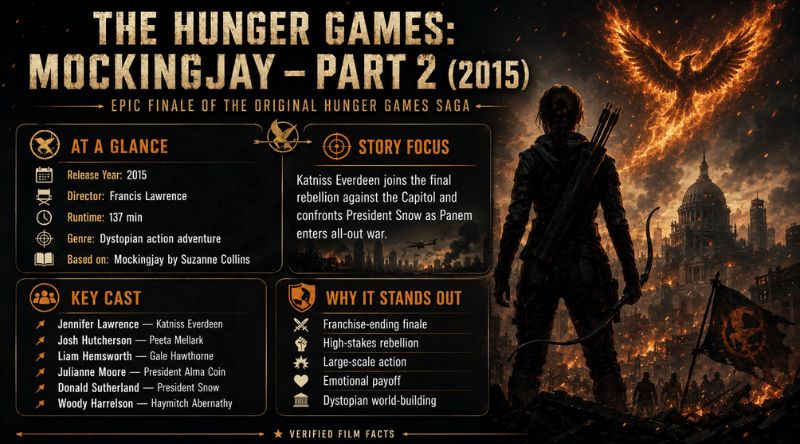
The revolution reaches its violent conclusion as Katniss and her closest allies launch a final, high-stakes assault on the heavily booby-trapped streets of the Capitol to assassinate President Snow.
This finale delivers a dark, uncompromising look at the cost of war. It avoids simple Hollywood happy endings, highlighting that corruption can exist on both sides of a revolution and questioning what true justice looks like.
| Feature | Key Fact / Benefit |
| Timeline Placement | The climax and conclusion of the timeline |
| Core Value | Provides a definitive, thought-provoking end to the Katniss Everdeen saga |
| Standout Element | Turns the entire city of the Capitol into a massive, trap-filled arena |
Path B: The Theatrical Release Order
If you are a first-time viewer, sticking to the order in which the films debuted in theaters is generally your safest bet.
Starting here lets you experience the franchise exactly the way the world did. You fall in love with Katniss first, which makes going back in time to watch the prequels much more impactful. Seeing Coriolanus Snow’s early life carries far more weight when you already know the tyrannical monster he eventually becomes.
Here is the exact order of their theatrical debuts:
- The Hunger Games (March 2012)
- The Hunger Games: Catching Fire (November 2013)
- The Hunger Games: Mockingjay – Part 1 (November 2014)
- The Hunger Games: Mockingjay – Part 2 (November 2015)
- The Hunger Games: The Ballad of Songbirds & Snakes (November 2023)
- The Hunger Games: Sunrise on the Reaping (2026)
How to Watch the Hunger Games Movies in Order: Frequently Asked Questions
Can I skip the prequel movies and still understand the main story?
Yes. The original four movies tell a completely self-contained, satisfying story centered on Katniss Everdeen. The prequels simply expand the world, enrich the lore, and add deep layers of psychological context to the characters and the history of the Capitol.
Why was the final book split into two separate movies?
Lionsgate split Mockingjay into two parts to mirror a major Hollywood trend of the mid-2010s seen in franchises like Harry Potter and Twilight. While this allowed for a highly detailed adaptation of the final book’s complex political themes, it noticeably slowed down the pacing of the first part.
Is there a direct connection between Lucy Gray Baird and Katniss Everdeen?
While they are not directly related by blood, they share deep thematic ties. Both are female tributes from District 12 who use music, performance, and sheer defiance to outsmart the Capitol. Lucy Gray is actually the original singer of “The Hanging Tree,” a song Katniss uses decades later to rally the rebellion.
Final Takeaway
Deciding how to watch the Hunger Games movies in order comes down to what kind of story you want to experience.
- Choose Chronological Order if you love deep world-building and want to watch the political history of Panem evolve naturally from the ground up.
- Choose Release Order if you are a newcomer who wants the highest emotional impact, letting you build a connection with Katniss before diving into the historical backstories.
Whichever path you choose, the journey through the districts remains one of the most cohesive, thought-provoking, and thrilling science-fiction marathons in modern cinema. Grab your popcorn, secure your gear, and may the odds be ever in your favor.