

Real life can be stranger, darker and more moving than anything a screenwriter could invent.
That’s why the best movies based on true stories often stay with us for years. We already know these events happened. Real people faced the danger, made the choices and lived with the consequences.
A great true-story movie doesn’t just repeat history. It pulls us into the room. It makes us feel the pressure behind a decision, the fear inside a crisis or the cost of speaking up.
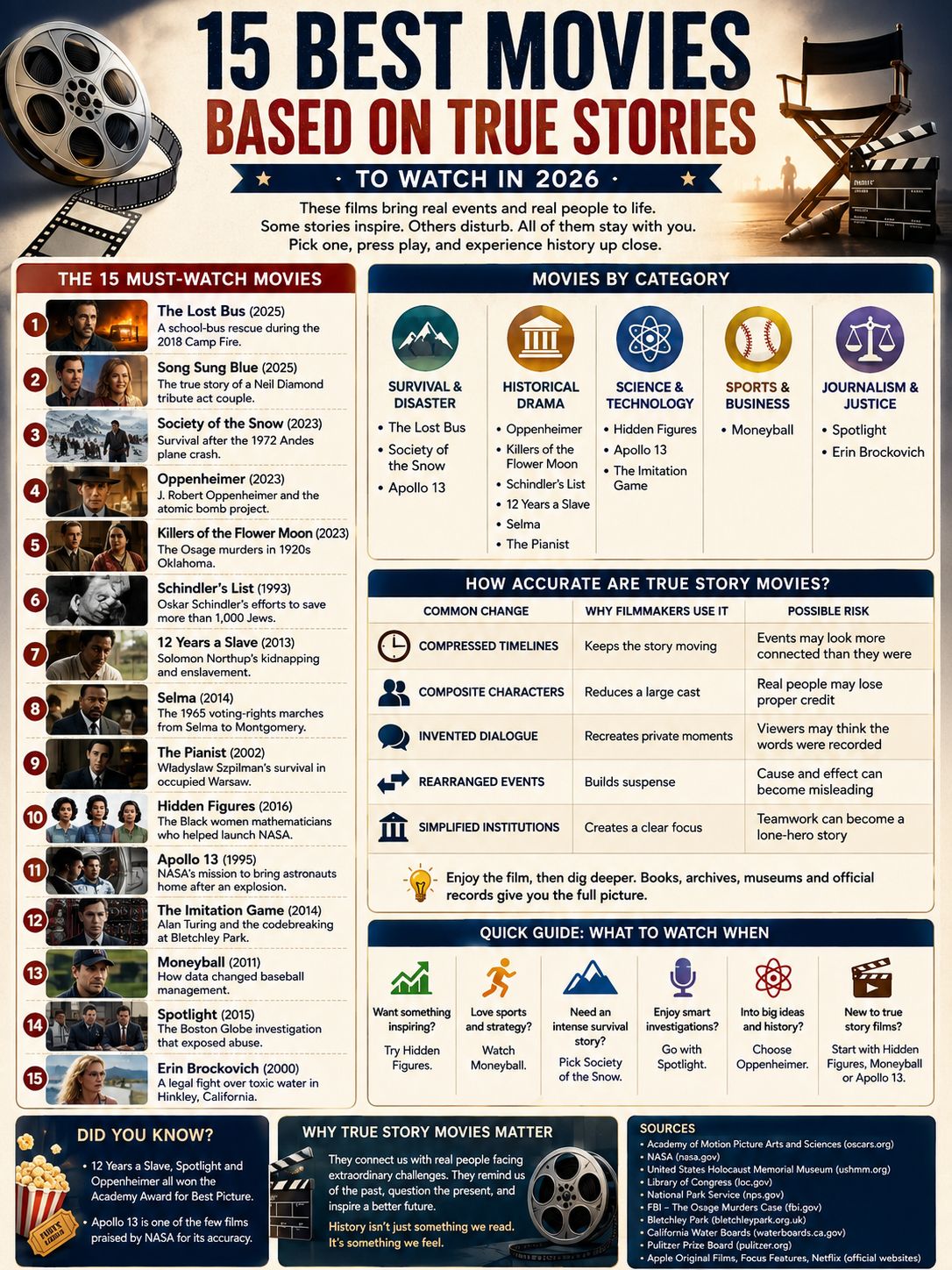
This list brings together recent releases and proven classics. You’ll find survival stories, historical dramas, science films, sports movies and investigations that changed public life.
Some films stick closely to the record. Others compress timelines, combine characters or invent private conversations. That doesn’t always make them dishonest, but it does mean they shouldn’t replace proper historical research.
Best Movies Based on True Stories: Quick Picks for 2026
Not every film suits every mood. Some are inspiring. Others are emotionally draining. A few are so tense that you may forget you already know the ending.
| Movie | Year | Real-life subject | Best for |
|---|---|---|---|
| The Lost Bus | 2025 | A school-bus escape during the Camp Fire | Disaster thrillers |
| Song Sung Blue | 2025 | A real Neil Diamond tribute act | Music and romance |
| Society of the Snow | 2023 | The Andes flight disaster | Survival drama |
| Oppenheimer | 2023 | J. Robert Oppenheimer and the atomic bomb | Science and political history |
| Killers of the Flower Moon | 2023 | The Osage murders | Historical crime |
| Schindler’s List | 1993 | Oskar Schindler’s rescue efforts | Holocaust history |
| 12 Years a Slave | 2013 | Solomon Northup’s enslavement | Memoir adaptations |
| Selma | 2014 | The 1965 voting-rights marches | Civil-rights history |
| The Pianist | 2002 | Władysław Szpilman’s survival | Wartime biography |
| Hidden Figures | 2016 | Black women mathematicians at NASA | Inspiring STEM stories |
| Apollo 13 | 1995 | NASA’s aborted Moon mission | Space and engineering |
| The Imitation Game | 2014 | Alan Turing and wartime codebreaking | Computing history |
| Moneyball | 2011 | Data-driven baseball management | Sports and business |
| Spotlight | 2015 | The Boston Globe abuse investigation | Journalism |
| Erin Brockovich | 2000 | The Hinkley water-contamination case | Legal drama |
Recent True-Story Movies Worth Watching in 2026
Recent true-story films have moved beyond the standard cradle-to-grave biopic. These movies focus on people facing one defining chapter of their lives.
| Movie | Main strength | Accuracy note |
| The Lost Bus | Fast-paced disaster storytelling | Uses characters inspired by real people |
| Song Sung Blue | Music, romance and emotional warmth | Adapted from a documentary about the couple |
| Society of the Snow | Intimate, survivor-led storytelling | Draws from testimony and published accounts |
1. The Lost Bus
Paul Greengrass takes the chaos of the 2018 Camp Fire and turns it into a tense rescue film.
Matthew McConaughey plays a school-bus driver trying to get 22 children out of danger. America Ferrera plays the teacher helping him keep the group calm as smoke, flames and blocked roads close in.
The film draws from Lizzie Johnson’s nonfiction book Paradise. Its central characters were inspired by real people, but the movie still uses dramatization.
That distinction matters. You’re watching a film shaped by real events, not a documentary recreation.
What makes it work is the sense of confusion. The danger doesn’t arrive in a neat order. Roads disappear. Information changes. People make decisions with little time and even less certainty.
The film later received a 2026 Academy Award nomination for visual effects.
2. Song Sung Blue
Song Sung Blue follows Mike and Claire Sardina, a Milwaukee couple who performed together as the Neil Diamond tribute act Lightning & Thunder.
Hugh Jackman and Kate Hudson play the pair as they chase a modest dream that becomes the centre of their relationship. Their story includes music, family strain, setbacks and painful loss.
The movie was adapted from Greg Kohs’s 2008 documentary about the real couple. Like most feature adaptations, it reshapes some events and condenses parts of the timeline.
Still, the heart of the story feels refreshingly ordinary. These aren’t global superstars. They’re working performers trying to build something meaningful together.
Kate Hudson later received a Best Actress nomination at the 98th Academy Awards.
3. Society of the Snow
In October 1972, Uruguayan Air Force Flight 571 crashed in the Andes. Forty-five people were aboard. Only 16 returned home.
J.A. Bayona’s Society of the Snow treats that story with unusual care.
The survivors spent 72 days trapped in extreme conditions. They faced freezing temperatures, hunger, injury and the growing fear that no one was coming.
The film draws from Pablo Vierci’s book and from conversations with survivors and victims’ families. It also gives attention to those who died, rather than treating them as background figures.
That choice gives the film weight. It’s not just about endurance. It’s about guilt, trust, sacrifice and the decisions people make when normal rules no longer apply.
The film earned two Academy Award nominations.
Historical Dramas That Still Matter
These films deal with war, slavery, political violence and civil rights. None of them is an easy watch, but each offers something worth confronting.
| Movie | Historical focus | What to expect |
| Oppenheimer | The Manhattan Project and its aftermath | Dense and morally uneasy |
| Killers of the Flower Moon | The murders of Osage people | Slow, disturbing crime drama |
| Schindler’s List | Rescue during the Holocaust | Devastating historical drama |
| 12 Years a Slave | Kidnapping and enslavement | Brutal memoir adaptation |
| Selma | Voting-rights activism in 1965 | Political strategy and protest |
| The Pianist | Survival in occupied Warsaw | Quiet, bleak and personal |
4. Oppenheimer
Christopher Nolan’s Oppenheimer follows physicist J. Robert Oppenheimer through the Manhattan Project and the political fallout that followed.
The film covers the creation of the atomic bomb, but its real subject is responsibility.
Oppenheimer becomes trapped between scientific achievement, military power and the human consequences of his work. Later, a security hearing damages his public standing, even though officials found no evidence that he had been disloyal to the United States.
The movie refuses to hand viewers a simple answer. It doesn’t present him as a pure hero or an obvious villain.
That uncertainty is exactly what makes it so effective.
Oppenheimer won seven Academy Awards, including Best Picture, Best Director and Best Actor.
Read Also: 15 Best Movie Plot Twists That Nobody Saw Coming
5. Killers of the Flower Moon
Martin Scorsese’s Killers of the Flower Moon examines the murders of Osage people in Oklahoma during the 1920s.
After oil was discovered on Osage land, members of the community became enormously wealthy through mineral headrights. That wealth made them targets for fraud, manipulation and murder.
The movie centres much of its story on Mollie Burkhart, an Osage woman whose family members begin dying under suspicious circumstances.
Leonardo DiCaprio plays Ernest Burkhart, a man caught between his marriage to Mollie and the criminal schemes of his uncle, played by Robert De Niro.
The film runs for more than three hours, but the length serves a purpose. It shows how violence can become part of a wider system, not just the work of one criminal.
The federal investigation became an important early case for the Bureau of Investigation, which later became the FBI.
The film received 10 Oscar nominations.
6. Schindler’s List
Steven Spielberg’s Schindler’s List tells the story of Oskar Schindler, a German businessman and Nazi Party member who used his factories and connections to protect Jewish workers.
Schindler did not begin as a heroic figure. He saw war as a chance to make money.
That makes his transformation more powerful. Over time, he starts using his position, wealth and influence to keep people from being deported and killed.
The United States Holocaust Memorial Museum credits him with helping more than 1,000 Jews survive.
The film won seven Academy Awards, including Best Picture and Best Director.
It remains one of the best movies based on true stories, but it’s an emotionally punishing experience. This is a film that deserves your full attention.
7. 12 Years a Slave
Solomon Northup was a free Black man living in New York. In 1841, two men lured him to Washington, D.C., kidnapped him and sold him into slavery.
He remained enslaved for 12 years.
After regaining his freedom, Northup published his memoir, Twelve Years a Slave, in 1853. Steve McQueen’s film uses that account as its foundation.
Chiwetel Ejiofor plays Northup with restraint. The performance never feels designed to make the audience comfortable.
The movie shows slavery as a legal, financial and social system held together by violence. It does not treat Northup’s suffering as an isolated tragedy.
The film won three Academy Awards, including Best Picture.
8. Selma
Ava DuVernay’s Selma follows the 1965 campaign for equal voting rights and the marches from Selma to Montgomery.
The march route covered about 54 miles.
On Bloody Sunday, law-enforcement officers attacked roughly 600 peaceful marchers as they crossed the Edmund Pettus Bridge.
The film works because it doesn’t turn the civil-rights movement into the story of one perfect leader. It shows planning, disagreement, political pressure and collective action.
David Oyelowo’s Martin Luther King Jr. is thoughtful, persuasive and human. He has doubts. He makes strategic choices. He also depends on a much larger movement.
Selma received a Best Picture nomination, while “Glory” won the Oscar for Best Original Song.
9. The Pianist
The Pianist tells the story of Władysław Szpilman, a Polish Jewish musician who survived the German occupation of Warsaw.
Adrien Brody plays him as a man slowly stripped of nearly everything: his work, his family, his home and eventually even regular human contact.
The film does not depend on constant speeches or dramatic confrontations. Its strongest moments are often silent.
Szpilman survives through help, luck and extraordinary endurance. Near the end of the war, German officer Wilm Hosenfeld discovers him and secretly provides food and protection.
The movie received seven Oscar nominations and won three, including Best Actor and Best Director.
True Stories About Science, Technology and Sport
Some of the most enjoyable true-story films deal with equations, engineering and data. They also remind us that major breakthroughs rarely come from one person working alone.
| Movie | Central idea | Main accuracy caveat |
| Hidden Figures | Black women’s work at NASA | More than 20 years are compressed |
| Apollo 13 | Engineering during a space emergency | Dialogue and timing are dramatized |
| The Imitation Game | Breaking German Enigma codes | Turing was part of a large team |
| Moneyball | Data-driven baseball decisions | The wider organisation is simplified |
10. Hidden Figures
Hidden Figures brought the stories of Katherine Johnson, Dorothy Vaughan and Mary Jackson to a wide audience.
All three women played important roles at NASA during the early years of the American space programme.
Johnson’s calculations supported Alan Shepard’s flight and John Glenn’s orbital mission. Vaughan became an expert programmer and supervisor. Jackson became NASA’s first Black female engineer.
The film compresses more than two decades into a tighter story. It also invents or reshapes several workplace scenes.
For example, Katherine Johnson did not make the repeated bathroom journey exactly as the movie shows. Still, racial segregation and discrimination were real parts of the workplace.
The movie shouldn’t be treated as a complete history. It works best as a doorway into the women’s actual achievements.
It earned three Academy Award nominations, including Best Picture.
11. Apollo 13
In April 1970, an oxygen tank exploded aboard Apollo 13.
The crew had been heading for the Moon. After the explosion, the landing was cancelled, and the mission became a fight to bring the astronauts home.
Jim Lovell, Fred Haise and Jack Swigert used the lunar module as a lifeboat. Meanwhile, NASA teams on Earth worked through problems involving power, carbon dioxide and navigation.
Ron Howard’s film makes calculations, checklists and teamwork genuinely exciting.
There’s no villain. The tension comes from limited time, failing equipment and the need to get every decision right.
NASA later called the mission a “successful failure.” The Moon landing never happened, but all three astronauts returned safely.
The film received nine Oscar nominations and won two.
12. The Imitation Game
Benedict Cumberbatch plays Alan Turing, the British mathematician who worked at Bletchley Park during the Second World War.
Turing helped develop methods and machines used to break German Enigma messages. His work mattered enormously.
Still, the film leans too heavily on the lone-genius idea.
Turing worked within a large codebreaking operation. Gordon Welchman, Joan Clarke, Bill Tutte and many others made major contributions. Polish mathematicians had also achieved crucial breakthroughs before British teams continued the work.
The film captures Turing’s brilliance and the injustice he later suffered. It does not fully capture the scale of the collaboration around him.
It received eight Oscar nominations and won Best Adapted Screenplay.
13. Moneyball
You don’t need to love baseball to enjoy Moneyball.
The real conflict is simple: tradition versus evidence.
Brad Pitt plays Oakland Athletics general manager Billy Beane, who uses statistical analysis to identify players other teams may have undervalued.
The approach helps the Athletics compete despite a limited payroll. During the 2002 season, the team won 103 games and set an American League record at the time with 20 straight victories.
The film simplifies the wider front office and gives extra weight to certain people. Still, it clearly explains how data can challenge professional habits that everyone assumes are correct.
For viewers who want one of the best movies based on true stories without war, disaster or extreme violence, this is an excellent choice.
The film earned six Academy Award nominations.
Journalism, Law and Public Accountability
These movies prove that phone calls, court files and careful research can be just as tense as any action sequence.
| Movie | Real-world case | Strongest feature |
| Spotlight | The Boston Globe’s clergy-abuse investigation | Detailed reporting process |
| Erin Brockovich | Chromium contamination in Hinkley | Strong lead performance and clear stakes |
14. Spotlight
Spotlight recreates the Boston Globe investigation into sexual abuse by Catholic priests and the systems that helped conceal it.
The film takes its time.
Reporters search old records. They speak with survivors. They question lawyers, church officials and their own assumptions. The work looks slow because real investigations often are.
That patience becomes the source of the film’s tension.
The Globe’s reporting received the 2003 Pulitzer Prize for Public Service. The film later won Academy Awards for Best Picture and Best Original Screenplay.
Among the best movies based on true stories, few show the reporting process with this much care.
15. Erin Brockovich
Julia Roberts plays Erin Brockovich, a legal clerk who helped investigate groundwater contamination near Pacific Gas and Electric’s compressor station in Hinkley, California.
State records show that chromium-based corrosion inhibitors entered unlined ponds during the 1950s and 1960s.
Residents later raised concerns about serious health problems. The legal dispute ended in a $333 million settlement in 1996.
The film succeeds because Brockovich does not behave like a polished legal hero. She’s direct, impatient and often underestimated.
Roberts brings humour and anger to the role without making the case feel trivial.
She won the Academy Award for Best Actress, and the film was also nominated for Best Picture.
How Accurate Are Movies Based on True Stories?
The words “based on a true story” don’t guarantee that every scene happened.
Filmmakers often change details to make a story clearer, shorter or more dramatic.
| Common change | Why filmmakers use it | What can go wrong |
| Compressed timelines | Keeps the plot moving | Events may look more connected than they were |
| Composite characters | Reduces a large cast | Real people can lose proper credit |
| Invented dialogue | Recreates private moments | Viewers may assume the words were recorded |
| Rearranged events | Builds suspense | Cause and effect can become misleading |
| Simplified institutions | Creates a clear central character | Teamwork becomes a lone-hero story |
These changes aren’t always a problem.
A movie has limited time. It may need to combine several meetings into one scene or reduce dozens of people to a few characters.
The problem begins when those changes rewrite the central truth.
Hidden Figures compresses decades. The Imitation Game underplays the size of the codebreaking team. The Lost Bus creates dramatized versions of real rescuers.
Watch these films for the human story. Then check the real history through memoirs, archives, museums, court records or strong investigative reporting.
Final Thoughts
The best movies based on true stories do more than recreate famous events. They bring us close to the people who lived through them.
Start with Hidden Figures when you want something inspiring. Pick Moneyball for a smart, entertaining sports story. Watch Society of the Snow for a gripping survival film or Spotlight for a patient investigation.
Choose Oppenheimer when you want big ideas and moral tension. Save Schindler’s List, 12 Years a Slave and The Pianist for a time when you can give them your full attention.
Most importantly, don’t stop when the credits roll.
A great film can spark curiosity. The real story often has even more to say.
Frequently Asked Questions
| Question | Quick answer |
| Does “based on” guarantee accuracy? | No |
| Are awards proof of historical accuracy? | No |
| Can fictional characters appear? | Yes |
| Should films replace books or documentaries? | No |
| Which titles are easiest to start with? | Hidden Figures, Moneyball and Apollo 13 |
Does “based on a true story” mean more than “inspired by”?
Usually, “inspired by” suggests that filmmakers took more creative freedom.
Still, neither phrase follows a fixed industry rule. A movie described as “based on” real events may still invent scenes or combine characters.
Are Oscar-winning true-story movies more accurate?
Not necessarily.
Awards recognise performances, directing, writing, design and other parts of filmmaking. They do not certify historical accuracy.
Which movies are best for someone new to true-story films?
Start with Hidden Figures, Moneyball or Apollo 13.
They’re easy to follow, emotionally engaging and less disturbing than films such as Schindler’s List or 12 Years a Slave.
Which movies need more fact-checking afterward?
The Imitation Game needs more context because the film simplifies the wider codebreaking effort.
Hidden Figures compresses many years into a shorter timeline. Selma also focuses on one part of a much broader civil-rights movement.
Can schools use true-story films in lessons?
Yes, but teachers should explain what the film changed.
A movie works well as a starting point. It should be paired with primary documents, biographies, museum material or academic sources.
What’s the easiest way to research the real story?
Start with the original memoir, biography, documentary or book behind the film.
Then compare it with records from museums, government agencies, courts or reputable news organisations.