
Today’s filmmakers can record animals in near-total darkness, follow insects at ground level, capture sounds people can’t normally hear, and rebuild extinct worlds with startling detail. The technology is better, but the real draw hasn’t changed. We still want to see how animals live when humans aren’t in the way.
The problem is finding the good stuff.
Netflix, Disney+, Apple TV, Peacock, and HBO Max all carry strong natural history titles. Some focus on huge landscapes. Others stay close to one animal, one family, or one fragile habitat.
This guide to the best nature documentaries stream services offer in 2026 cuts through the crowded catalogs. It includes recent releases, modern classics, family-friendly series, and a few documentaries that deserve more attention.
Streaming availability was checked in July 2026. Catalogs, prices, age ratings, and download options can differ by country.
The Best Nature Documentaries to Stream in 2026
This list covers living wildlife, prehistoric animals, ocean recovery, migration, conservation, and animal intelligence. It includes both feature films and multi-part series.
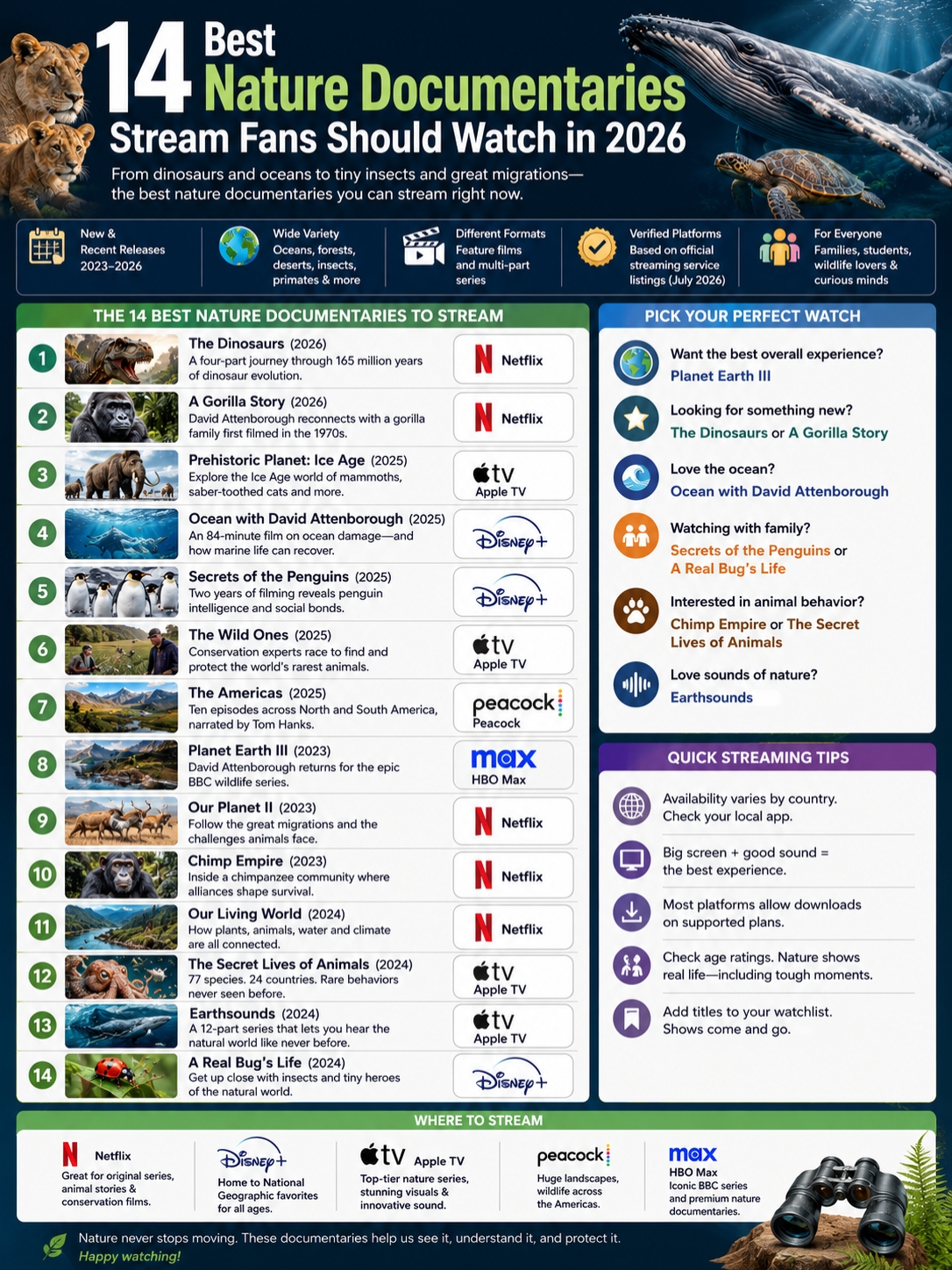
| Title | Release Year | Main Subject | Verified Platform | Best For |
| The Dinosaurs | 2026 | Dinosaur evolution | Netflix | Families and prehistoric-life fans |
| A Gorilla Story | 2026 | Mountain gorillas | Netflix | Emotional wildlife storytelling |
| Prehistoric Planet: Ice Age | 2025 | Ice Age animals | Apple TV | Science-led prehistoric viewing |
| Ocean with David Attenborough | 2025 | Ocean recovery | Disney+ | Marine conservation |
| Secrets of the Penguins | 2025 | Penguin societies | Disney+ | Families and bird lovers |
| The Wild Ones | 2025 | Endangered species | Apple TV | Fieldwork and conservation |
| The Americas | 2025 | Wildlife across two continents | Peacock | Large-scale photography |
| Planet Earth III | 2023 | Global habitats | HBO Max | Premium wildlife filmmaking |
| Our Planet II | 2023 | Animal migration | Netflix | Fast-moving natural history |
| Chimp Empire | 2023 | Chimpanzee society | Netflix | Character-led animal drama |
| Our Living World | 2024 | Connected ecosystems | Netflix | Ecology and environmental science |
| The Secret Lives of Animals | 2024 | Animal intelligence | Apple TV | Rare animal behavior |
| Earthsounds | 2024 | Natural sound | Apple TV | Immersive audio |
| A Real Bug’s Life | 2024 | Insects and small animals | Disney+ | Family viewing |
The platforms listed above come from official service pages. That doesn’t mean every title will appear in every country, so check your local app before subscribing.
How We Chose These Nature Documentaries
A famous narrator and expensive camera gear can’t save a weak documentary. The best productions need more than pretty images.
They should reveal something useful. That might be a rare behavior, a clearer view of an ecosystem, or a better understanding of how animals survive.
| Selection Factor | What We Looked For |
| Scientific grounding | Input from researchers, natural history teams, or field experts |
| Visual value | Footage or reconstruction that reveals hard-to-see behavior |
| Storytelling | A clear narrative instead of random animal clips |
| Subject range | Oceans, forests, insects, primates, migration, and extinct life |
| Current relevance | Titles that remain available or were released recently |
| Viewer value | A clear reason to choose the title over similar documentaries |
Nature documentaries still shape real events into stories. Editors shorten timelines. Narrators simplify difficult ideas. Music can make a hunt feel more dramatic than it looked in the field.
That doesn’t make the work misleading by default. It simply means viewers should treat even the best documentary as a starting point, not the final word on a scientific subject.
Read Also: Best Horror Movies on Shudder to Stream in 2026
Best Nature Documentaries Stream Services Offer in 2026
1. The Dinosaurs
Where to stream: Netflix
Release year: 2026
Best for: Dinosaur fans, families, and evolutionary history
The Dinosaurs is a four-part Netflix series narrated by Morgan Freeman. It covers around 165 million years of dinosaur history, from their early rise to the extinction event that ended their dominance.
The series works because it gives the story a clear timeline. It doesn’t just jump between famous species. Instead, it shows how climate, habitats, food supplies, and competition changed over millions of years.
That wider view helps the dinosaurs feel like real animals rather than movie monsters.
Every creature is digitally recreated, of course. Still, the production treats them as part of functioning ecosystems. Hunting scenes are present, so parents may want to preview the series before watching with very young children.
| Key Detail | Information |
| Format | Four-part series |
| Narrator | Morgan Freeman |
| Main strength | Clear evolutionary timeline |
| Main drawback | All animal behavior is reconstructed |
2. A Gorilla Story: Told by David Attenborough
Where to stream: Netflix
Release year: 2026
Best for: Primates, conservation history, and emotional storytelling
Released in April 2026, A Gorilla Story links David Attenborough’s early encounter with a young gorilla named Pablo to the lives of Pablo’s descendants in present-day Rwanda.
That long timeline gives the film unusual weight.
This isn’t just another documentary about gorillas feeding, playing, and protecting their young. It also looks at how conservation, research, filmmaking, and human attitudes have changed across several decades.
Attenborough’s personal connection adds warmth, but the film doesn’t lean on nostalgia alone. Its strongest moments come from the gorillas themselves, especially their family bonds and social behavior.
| Key Detail | Information |
| Format | Feature documentary |
| Main location | Rwanda |
| Central subject | Pablo and his descendants |
| Main strength | Archival footage paired with present-day filming |
3. Prehistoric Planet: Ice Age
Where to stream: Apple TV
Release year: 2025
Best for: Ice Age animals and realistic prehistoric worlds
Prehistoric Planet: Ice Age moves beyond dinosaurs and into the age of mammoths, woolly rhinoceroses, saber-toothed cats, giant ground sloths, and other remarkable animals.
The five-part series comes from BBC Studios Natural History Unit. Tom Hiddleston narrates, while Hans Zimmer, Anže Rozman, and Kara Talve worked on the music.
The creatures are digitally created, but the series doesn’t treat them like fantasy beasts. They eat, migrate, compete, raise young, and respond to changing climates.
That grounded approach makes a big difference. The animals feel like wildlife, not special effects.
| Key Detail | Information |
| Format | Five episodes |
| Narrator | Tom Hiddleston |
| Production team | BBC Studios Natural History Unit |
| Main strength | Realistic treatment of extinct ecosystems |
4. Ocean with David Attenborough
Where to stream: Disney+
Release year: 2025
Best for: Marine ecosystems and practical conservation
Ocean with David Attenborough is a feature-length documentary rather than a series. It runs for about 84 minutes and examines both the damage done to marine habitats and the possibility of recovery.
The film doesn’t hide the impact of industrial fishing and habitat loss. Some scenes are difficult to watch.
Yet it avoids the trap of ending with nothing but despair.
Its central point is simple and important: damaged ocean habitats can recover when destructive activity stops and proper protection begins. That gives the documentary a sense of direction many environmental films lack.
| Key Detail | Information |
| Format | Feature documentary |
| Runtime | About 84 minutes |
| Main focus | Ocean damage and recovery |
| Main strength | A clear conservation message with room for hope |
5. Secrets of the Penguins
Where to stream: Disney+
Release year: 2025
Best for: Families, bird lovers, and social animal behavior
Secrets of the Penguins looks past the familiar image of penguins standing on Antarctic ice.
National Geographic Explorer Bertie Gregory spent two years filming penguins in very different environments. The series covers intelligence, cooperation, risk-taking, family life, and learned behavior.
That range makes it more interesting than a standard species profile.
Different penguins live in deserts, on temperate coasts, on remote islands, and near human communities. Their survival depends on much more than coping with cold weather.
Blake Lively narrates the series. The tone stays accessible, which makes it a good family choice.
| Key Detail | Information |
| Format | Documentary series |
| Filming period | Two years |
| Narrator | Blake Lively |
| Main strength | Shows penguins living far beyond Antarctica |
6. The Wild Ones
Where to stream: Apple TV
Release year: 2025
Best for: Conservation work and endangered wildlife
The Wild Ones puts researchers and conservation specialists directly into the story.
The six-part series follows teams as they search for threatened species, collect information, and work in remote or difficult environments. The animals remain the focus, but viewers also see the planning and fieldwork behind conservation.
That human element gives the series a different feel from traditional wildlife television.
Finding an endangered animal is only the beginning. Researchers must track it safely, gather reliable data, avoid causing stress, and work with local communities. The series gives that process the attention it deserves.
| Key Detail | Information |
| Format | Six episodes |
| Main focus | Endangered-species fieldwork |
| Human presence | Central to the story |
| Main strength | Shows what conservation looks like in practice |
7. The Americas
Where to stream: Peacock
Release year: 2025
Best for: Huge landscapes and geographic variety
Narrated by Tom Hanks, The Americas travels across North and South America, covering the Amazon, Andes, Caribbean, Patagonia, Mexico, Arctic regions, and major coastlines.
Hans Zimmer’s music adds weight to the scenery, but the series isn’t only about wide aerial shots. It also finds small, personal animal stories within those enormous landscapes.
The scale is the real attraction.
This is a strong pick for viewers who don’t want ten episodes about one species. Every location brings new climates, animals, and survival problems.
| Key Detail | Information |
| Format | Ten episodes |
| Narrator | Tom Hanks |
| Composer | Hans Zimmer |
| Main strength | Strong sense of place and continental scale |
8. Planet Earth III
Where to stream: HBO Max
Original release: 2023
Best for: The complete premium wildlife experience
Planet Earth III is still one of the safest recommendations in natural history television.
David Attenborough returns as narrator, guiding viewers through oceans, deserts, forests, coasts, freshwater systems, and habitats shaped heavily by human activity.
The photography is stunning, as expected. What gives the series more force is its environmental honesty.
Older wildlife documentaries often saved the difficult message for the final few minutes. Planet Earth III weaves habitat loss, pollution, climate pressure, and urban growth into the animal stories from the start.
For anyone looking for the best nature documentaries stream platforms currently offer, this is the best all-round starting point.
| Key Detail | Information |
| Format | Multi-episode global series |
| Narrator | David Attenborough |
| Main focus | Wildlife in changing habitats |
| Main strength | Spectacle backed by real environmental context |
9. Our Planet II
Where to stream: Netflix
Release year: 2023
Best for: Migration and fast-moving wildlife stories
The second season of Our Planet focuses on movement.
Animals travel to find food, breeding grounds, safer habitats, and the right temperatures. Along the way, they face roads, farms, cities, predators, and increasingly unpredictable weather.
Migration gives each episode a natural sense of urgency. The animals can’t simply wait for conditions to improve. They have to keep moving.
The editing is quicker than in many older wildlife series, so this is a good choice for viewers who find traditional nature documentaries too slow.
| Key Detail | Information |
| Main theme | Migration |
| Narrator | David Attenborough |
| Pace | Faster than many traditional series |
| Main strength | Connects animal movement with environmental change |
10. Chimp Empire
Where to stream: Netflix
Release year: 2023
Best for: Primate society and character-driven storytelling
Chimp Empire follows a large chimpanzee community in Uganda.
The chimps form alliances, compete for status, care for young, patrol borders, and respond to rival groups. Mahershala Ali narrates the limited series.
What makes it work is the attention given to individual animals. Viewers gradually learn who matters, who holds influence, and how relationships shift.
The filmmakers avoid turning every action into a simple human comparison. The chimps remain wild animals with their own social rules.
Territorial fights can be violent, so this may not suit sensitive children.
| Key Detail | Information |
| Location | Uganda |
| Narrator | Mahershala Ali |
| Main theme | Social politics within a chimpanzee community |
| Content warning | Animal injury and territorial violence |
11. Our Living World
Where to stream: Netflix
Release year: 2024
Best for: Ecology and connected natural systems
Narrated by Cate Blanchett, Our Living World looks at the links between animals, plants, water, climate, and landscapes.
It spends less time asking which animal is the strongest or fastest. Instead, it asks what allows an ecosystem to keep working.
A change in rainfall can affect plants. That affects food. Food affects migration, breeding, predators, and survival.
The series explains those connections clearly without turning into a classroom lecture. It’s a smart choice for older students and viewers who want more than dramatic hunting footage.
| Key Detail | Information |
| Format | Four episodes |
| Narrator | Cate Blanchett |
| Main theme | Ecological connections |
| Main strength | Explains how distant natural processes affect one another |
12. The Secret Lives of Animals
Where to stream: Apple TV
Release year: 2024
Best for: Animal intelligence and unusual behavior
This ten-part series covers 77 species across 24 countries. Filming took three years, and the production recorded several behaviors that had not previously been shown on television.
Hugh Bonneville narrates.
The episodes explore parenting, courtship, communication, friendship, problem-solving, and adaptation. Rather than staying in one habitat, the series follows major stages and challenges in animal life.
Its best moments are often quiet ones.
A route, tool, call, or choice of partner can tell us more about an animal than another slow-motion chase.
| Key Detail | Information |
| Format | Ten episodes |
| Species featured | 77 |
| Countries filmed | 24 |
| Narrator | Hugh Bonneville |
13. Earthsounds
Where to stream: Apple TV
Release year: 2024
Best for: Animal communication and immersive sound
Earthsounds turns sound into the main event.
The 12-part series was filmed across 20 countries on all seven continents. The production collected more than 3,000 hours of audio, including calls, songs, vibrations, warning signals, and sounds people rarely notice.
Tom Hiddleston narrates, but the animals do most of the talking.
A good pair of headphones makes a real difference here. Phone speakers flatten the detail and remove much of what makes the series special.
| Key Detail | Information |
| Format | 12 episodes |
| Narrator | Tom Hiddleston |
| Audio collected | More than 3,000 hours |
| Main strength | Treats natural sound as the main storytelling tool |
14. A Real Bug’s Life
Where to stream: Disney+
Release years: 2024 onward
Best for: Children, insects, and miniature wildlife
Narrated by Awkwafina, A Real Bug’s Life follows insects and other tiny animals through cities, jungles, ponds, forests, beaches, and backyards.
Specialist cameras turn small spaces into huge landscapes.
A pavement crack becomes a canyon. A puddle becomes a dangerous wetland. A garden can feel as wild as a rainforest.
The tone is playful, but the behavior is real. Children get clear explanations, while adults can appreciate the camera work and the strange complexity of insect life.
| Key Detail | Information |
| Narrator | Awkwafina |
| Main subject | Insects and other small animals |
| Tone | Light and family-friendly |
| Main strength | Makes familiar places feel genuinely wild |
Which Nature Documentary Should You Watch First?
The right choice depends on your mood.
You might want a calm family watch, a visually huge series, a strong conservation story, or something that moves quickly.
| What You Want | Best Starting Point |
| Best overall global series | Planet Earth III |
| Best new 2026 film | A Gorilla Story |
| Best new 2026 series | The Dinosaurs |
| Best prehistoric mammals series | Prehistoric Planet: Ice Age |
| Best ocean documentary | Ocean with David Attenborough |
| Best family choice | Secrets of the Penguins |
| Best insect series | A Real Bug’s Life |
| Best primate story | Chimp Empire |
| Best sound experience | Earthsounds |
| Best ecology series | Our Living World |
| Best conservation fieldwork | The Wild Ones |
| Best large-scale scenery | The Americas |
Parents should remember that “nature documentary” doesn’t always mean gentle viewing.
Predation, injury, starvation, mating, abandonment, and death are common parts of wildlife stories. Check local ratings and episode descriptions before watching with younger children.
What to Know About Streaming Availability
Streaming rights change often.
A documentary may appear on an official platform page but still be unavailable in your country. Local licensing agreements, language support, age ratings, and service launches can all affect access.
| Availability Issue | What to Check |
| Regional licensing | Search for the title inside your local app |
| Subscription level | Confirm that the title is included in your plan |
| Download support | Check the title page and device rules |
| Video quality | See whether 4K needs a higher-priced plan |
| Language options | Review available audio and subtitles |
| Removal dates | Look for expiry notices in your watchlist |
Netflix and Apple originals usually receive broad international releases. Peacock has more limited coverage outside the United States. Disney+ and HBO Max also carry different catalogs in different regions.
The safest approach is simple. Search the exact title inside the service before paying for a subscription.
Final Thoughts
The best nature documentaries don’t rely on beautiful footage alone.
They help us understand why animals migrate, communicate, compete, cooperate, and adapt. They also show how closely wildlife depends on climate, food, water, and healthy habitats.
Start with Planet Earth III for the most complete experience. Choose A Gorilla Story for something personal, The Dinosaurs for a major 2026 release, or Prehistoric Planet: Ice Age for extinct animals brought back with impressive care.
Families should try Secrets of the Penguins or A Real Bug’s Life. Conservation-minded viewers can begin with Ocean with David Attenborough or The Wild Ones. For animal behavior, Chimp Empire, The Secret Lives of Animals, and Earthsounds are hard to beat.
The best nature documentaries stream platforms offer in 2026 show a world that is clever, connected, vulnerable, and often much stranger than fiction.
Frequently Asked Questions
| Question | Quick Answer |
| Are the documentaries scientifically accurate? | Usually, but narration and editing may simplify the science |
| Are prehistoric scenes proven facts? | Some are based on evidence, while others rely on informed interpretation |
| Which title looks best in 4K? | Planet Earth III, The Americas, and Ocean |
| Which has the best sound? | Earthsounds |
| Can children watch The Dinosaurs? | Older children may enjoy it, but parents should preview hunting scenes |
| Can titles be downloaded? | Often, depending on the platform, plan, and region |
Are Nature Documentaries Scientifically Accurate?
The best productions work with researchers, field experts, and experienced natural history teams.
Still, every documentary shapes real footage into a story. Narrators may simplify uncertainty, and editors may place events closer together than they happened.
Use documentaries as an accessible introduction. For deeper research, turn to scientific papers, museum resources, and expert publications.
Do Prehistoric Documentaries Show Proven Animal Behavior?
Not always.
Fossils can reveal anatomy, age, diet, injuries, movement, and relationships between species. Behavior is much harder to confirm.
Filmmakers combine fossil evidence with biomechanics, environmental data, and comparisons with living animals. Some scenes are well supported. Others remain informed interpretation.
Which Nature Documentary Is Best for a 4K Television?
Planet Earth III, The Americas, Ocean with David Attenborough, and Prehistoric Planet: Ice Age are all strong choices.
Wide landscapes, detailed animal textures, dark underwater scenes, and fast movement benefit from a large, high-resolution display.
Which Documentary Has the Best Sound?
Earthsounds is the obvious pick.
The entire series is built around calls, vibrations, songs, and other forms of animal communication. Headphones reveal far more detail than a phone or laptop speaker.
Can Children Watch The Dinosaurs?
Netflix rates the series TV-PG in the United States, though ratings may differ elsewhere.
The series includes predation, extinction, and threatening animals. Older children who enjoy dinosaurs will probably be fine, but parents should preview it before showing it to younger or sensitive viewers.
Is Ocean with David Attenborough a Series?
No.
It is a feature-length documentary with a running time of about 84 minutes. Some online listings may group it with documentary series, but it is a single film.
Can Nature Documentaries Be Downloaded for Offline Viewing?
Many major streaming services allow offline downloads on supported plans and devices.
The rules depend on the title, subscription level, device, and country. Check the download icon or help section inside your local app.